Who We Are

Our Mission

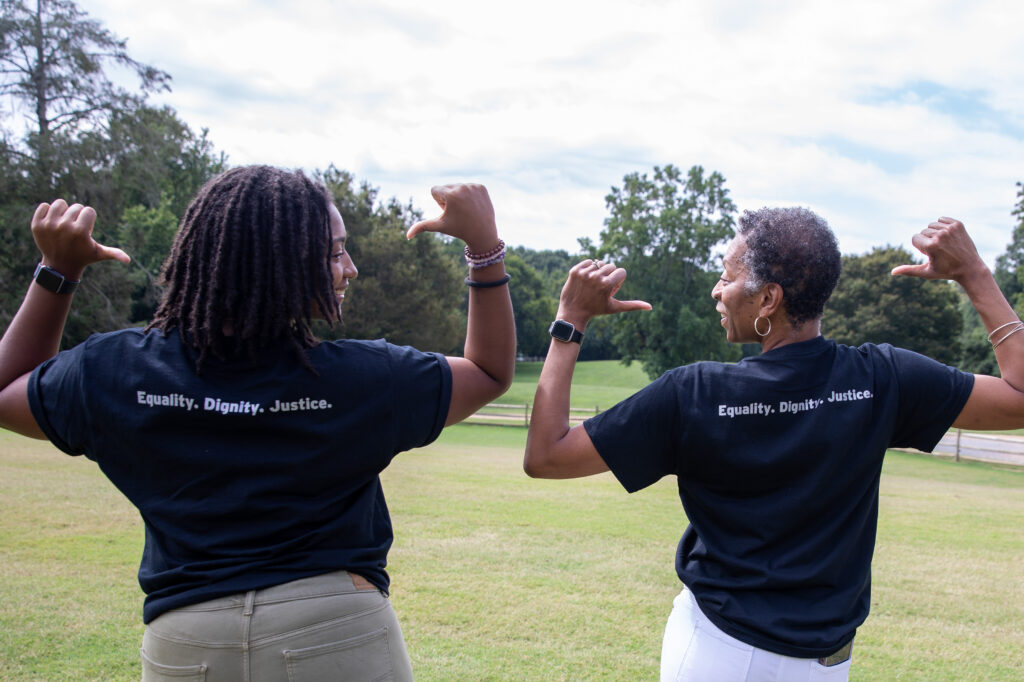
The Southern Center for Human Rights is working for equality, dignity, and justice for people impacted by the criminal legal system in the Deep South. SCHR fights for a world free from mass incarceration, the death penalty, the criminalization of poverty, and racial injustice.

Our History Milestones

Gates v. Collier

Exposed Mississippi State Penitentiary conditions in case that that led to SCHR's founding.

Nelson v. Leeke

Reformed South Carolina's entire 27-prison system.

Head v. King

Successfully challenged Louisiana's Angola Penitentiary treatment of prisoners suffering from mental illness.

Holloway v. State

Led Georgia to become first state banning execution of people with intellectual disability.

Amadeo v. Zant

Successfully challenged racial discrimination in jury selection at the Supreme Court.

Horton v. Zant

Overturned conviction due to systematic racial discrimination in jury strikes.

Georgia Prison Violence Cases

Ended brutal tactical raids under Commissioner Wayne Garner.

Foster v. Fulton County

Reformed HIV care at Fulton County Jail.

Dawson v. State

Secured Georgia Supreme Court ruling that death by electrocution violates the State's constitutional protection against cruel and unusual punishment.

Bowling v. Lee

Ended coerced guilty pleas in Coweta County.

Hampton v. Forrester

Exposed assembly-line justice, led to historic passage of 2003 Indigent Defense Act.

Leatherwood v. Campbell

Stopped preventable deaths at Alabama's brutal Limestone prison.

Laube v. Haley

Reformed conditions at Alabama's Tutwiler Prison for Women.

Harper v. Fulton County

Ongoing jail conditions litigation; this is SCHR’s third lawsuit challenging the persistent overcrowding, understaffing, and inhumane conditions at the Fulton County Jail.

Reece v. Donald

Sued Georgia DOC for contempt of a pre-existing consent order from a 1991 federal class-action lawsuit regarding prison conditions; lawsuit led state to convert Lee Arrendale State Prison from a young male offender facility to an all-women's prison in early 2005.

Whitaker v. Perdue

Challenge to Georgia’s sex offender registry provisions on behalf of low-level offenders; ultimately led to passage of a 2010 law that allowed certain individuals to petition courts for removal from the registry.

Snyder v. Louisiana

Won Supreme Court reversal of death sentence due to racial discrimination in jury selection.

Veto of HB 837

In 2014, successfully advocated for a veto of HB 837, which would have allowed private probation companies to shield details of their practices from public eyes while continuing to collect millions from people on probation.

Foster v. Chatman

Won Supreme Court ruling overturning death sentence due to racial discrimination in jury selection.

Harrison v. Columbus

Successfully ended the practice of charging victim witness fees to domestic violence survivors in Columbus, Georgia.

McWilliams v. Dunn

Won Supreme Court ruling establishing right to independent mental health expert in capital cases.

Georgia NAACP v. City of LaGrange

Challenged denial of utility services for court debt under Fair Housing Act.

Georgia v. Pearson

Successfully defended Olivia Pearson, a grandmother acquitted of felony charges for helping a first-time voter.

Gumm v. Sellers

Reached settlement reforming Georgia's Special Management Unit solitary confinement practices.

Clemency for Jimmy Meders

Won clemency for SCHR client Jimmy Meders hours before his scheduled execution, and a commutation of his sentence to life without parole.

State v. Gates

With the Georgia Innocence Project, secured the release of Johnny Gates, who spent 43 long years of wrongful imprisonment (26 on death row) based on newly discovered exculpatory DNA evidence and evidence of systematic race discrimination in jury selection.

Middleton v. Ward

Lawsuit challenging inhumane conditions of confinement at Georgia State Prison; voluntarily dismissed after officials shut down the prison in 2022.

Georgia Advocacy Office v. Labat

Won settlement requiring improved conditions for people with mental illness in South Fulton Jail; Sheriff Labat found in contempt twice (in 2024 and 2025) for failing to comply with court-ordered reforms.

DOJ Investigation of Georgia Prisons

Successfully advocated for federal Department of Justice statewide investigation into violence and suicide crisis in Georgia's prison system; advocacy continues as conditions have failed to improve.

Georgia Public Defender Council In Crisis

Launched public records database and advocacy campaign exposing systemic failures, with over 600 people awaiting lawyers and some detained up to 10 years without representation.

Stop "Cop City" First Amendment Defense Project

Created first-of-its-kind infrastructure to provide legal representation for 61 protesters facing RICO charges, believed to be the largest racketeering prosecution brought against protesters in U.S. history.

Williams v. City of Cartersville

Settlement challenging mass arrest of 60+ predominantly Black and Brown partygoers for minor marijuana possession.

Coronell, et al. v. Georgia

Class action challenging denial of individual bail determinations.

Passage of HB 123

Successfully advocated for landmark passage of Georgia death penalty intellectual disability reform, requiring separate determination of intellectual disability from guilt phase in capital cases.

Our History

SCHR was founded in 1976 by ministers and activists concerned about criminal justice issues in response to the Supreme Court’s reinstatement of the death penalty that year and to the horrendous conditions in Southern prisons and jails.

The Southern Center for Human Rights (SCHR) was founded in 1976 by ministers and activists concerned about criminal justice issues in response to the Supreme Court’s reinstatement of the death penalty that year and to the horrendous conditions in Southern prisons and jails. Its creation followed the historic case of Gates v. Collier, 349 F.Supp. 881 (N.D. Miss.1972). affirmed, Gates v. Collier, 501 F.2d 1291 (5th Cir. 1974), brought in federal court in the Northern District of Mississippi, which ending egregious constitutional violations at the Mississippi State Penitentiary (Parchman Farm). For a detailed description of the horrific abuses at Parchman Farm, click on the two court decisions. For a description of Mississippi’s use of its criminal justice system to maintain white supremacy after Emancipation through convict leasing and Parchman Farm, see David M. Oshinsky, Worse than Slavery: Parchman Farm and the Ordeal of Jim Crow Justice (Free Press 1996).

Originally named the Southern Prisoners Defense Committee, the organization’s attorneys and investigators struggled alongside civil rights organizations, families, and faith-based organizations to protect the civil and human rights of people of color, poor people, and other disadvantaged people facing the death penalty or confined to prisons and jails in the South.

After the 1970s, the criminal justice system exploded in size and reach. After holding steady for 150 years, the number of people imprisoned in the United States increased from around 200,000 to over 2 million. The United States now has the highest incarceration rate of any nation in the world.

In addition to providing representation to people facing the death penalty, SCHR employs class action lawsuits and individual representation in challenging unconstitutional and unconscionable practices within the criminal justice system. It also engages in public education and joint efforts with other organizations and individuals to oppose the death penalty and overcrowding of prisons and jails, to advocate for effective representation for poor people accused of crimes, just and humane sentencing policies and the fair, equal, and humane treatment of all people who come into the criminal justice system.

For more on SCHR’s 40-year history, read Justice Taking Root: The 40 Year History of the Southern Center for Human Rights.
Subscribe to stay informed, engaged, and connected to the work of defending dignity and advancing justice.